
Routing Zhang’s illustrated avatar, smiling in a pink PSY shirt

Hi, I'm Routing Zhang.Welcome to my website!

About

I am a Master's student in Psychology at Beijing Normal University, China.

I am particularly interested in social hierarchies, inequality, and how they shape the ways people think, feel, and interact with one another. At the same time, I enjoy exploring new questions and remain open to where my curiosity might take me.

To explore these questions, I have been learning to use methods such as large-scale data analysis, archival research, and laboratory experiments. As I continue my research journey, I hope to broaden my methodological toolkit and explore new approaches, especially qualitative research, which I plan to use for my master's thesis.

I expect to graduate in June 2028 and hope to pursue a PhD in social psychology afterward. I would be very grateful for any information about potential opportunities or advice on pursuing doctoral studies. Please feel free to reach out!

Research

Black-and-white drawing of two men in different suits, labeled 寒门贵子 versus 富二代

CONFERENCE PRESENTATION · 2026

Beyond Qualifications: How Social Class Origin Shapes Leadership Emergence

Zhang, R., & Cheng, L. (2026). Beyond qualifications: How social class origin shapes leadership emergence [Conference presentation]. Annual Conference of the Chinese Association of Social Psychology (中国社会心理学年会).

Imagine two employees with the same educational background, qualifications, and job position. One grew up in a well-resourced family, while the other came from a disadvantaged background. When it comes to identifying a potential leader, would they be given the same chance?

Across five studies, combining 20 years of Chinese national survey data, Chinese and English language models, and experiments with employees and managers, we found that social class origin continues to shape who is seen as a potential leader, even when current qualifications are held constant. Surprisingly, this disadvantage was not driven by differences in perceived competence. Instead, employees from lower-class origins were perceived as less assertive—less likely to speak up, stand their ground, or influence others. When clear evidence of their assertive behavior was provided, the class-origin gap in leadership evaluations narrowed substantially.

Our findings reveal a subtle way social inequality can persist even after upward mobility: people may be recognized for what they can do, yet still be overlooked for who they could become. Breaking the class ceiling, therefore, may require not only creating equal opportunities, but also rethinking how we recognize leadership potential.
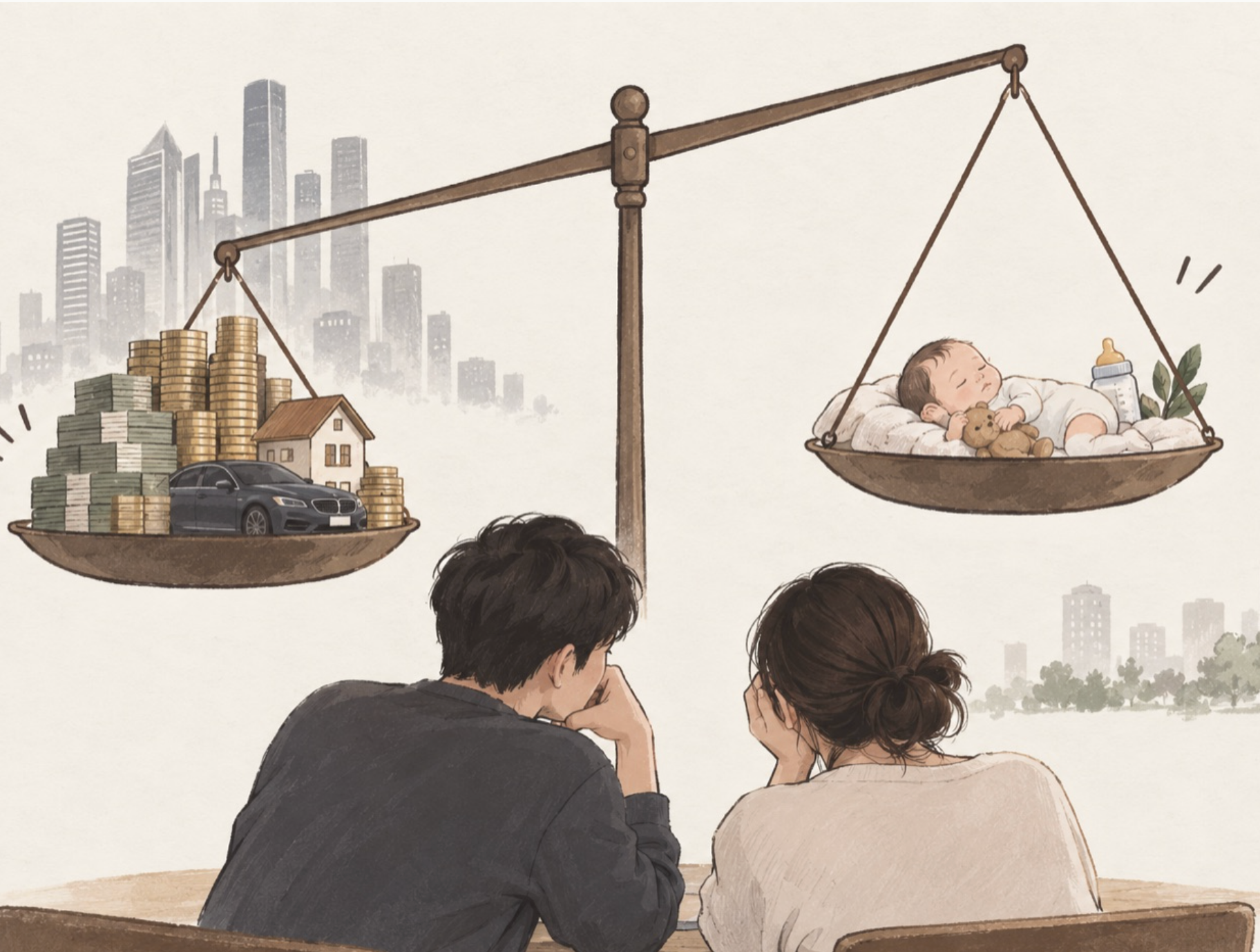

Warm hand-drawn illustration of a couple facing a scale: wealth, a house, and a car on one side, and a sleeping baby on the other

JOURNAL ARTICLE · ONLINE FIRST

The Purse and Cradle: The Effect of Perceived Economic Inequality on Fertility Intentions

Cheng, L.#, Zhang, R.#, Wang, F., Guo, Y., & Chen, P. (2026). The purse and cradle: The effect of perceived economic inequality on fertility intentions. 心理学报 (Acta Psychologica Sinica). Online first. [PDF]# denotes co-first authorship.

Why might a wider wealth gap make people less willing to have children? We argue that perceived economic inequality does more than divide resources—it changes how people imagine the future.

Across four studies (five sub-studies), we combined over 400,000 social-media posts, a nationally representative survey, a questionnaire study, and experiments conducted in China and the United States. The evidence converged: when people perceived greater economic inequality, they reported lower fertility intentions. This happened partly because inequality heightened anxiety about their own financial standing, but even more because it made future parenthood feel costly, demanding, and difficult to manage. Anticipated parenting stress emerged as the most consistent psychological pathway across methods and cultures.

By showing how a macro-level social condition enters one of life's most personal decisions, this research suggests that inequality may shape not only how people live today, but also whether they feel able to imagine raising the next generation.

A runner on a coastal nature trail, with the ocean and mountains in soft morning light

JOURNAL ARTICLE · 2026

From Awe to Wellness: How Awe Encourages Health-Promoting Lifestyles Through Authentic-Self Pursuit

Cheng, L.#, Zhang, R.#, Yu, X., Zhang, Y., Mao, J., & Wang, X. (2026). From awe to wellness: How awe encourages health-promoting lifestyles through authentic-self pursuit. The Journal of Positive Psychology. [PDF]

Imagine standing above a sea of clouds, gazing at a sky full of stars, or listening to a piece of music that takes your breath away. In moments like these, the world suddenly feels bigger, and our everyday worries seem a little smaller. Psychologists call this feeling awe. But could these moments of wonder also inspire us to live healthier lives?

Across five studies (N = 1,285), combining longitudinal surveys and experiments, we found that people who experienced more awe tended to engage in healthier lifestyles over time, while experimentally induced awe increased intentions to adopt healthier habits. An important reason was authentic-self pursuit: awe encourages us to look beyond our everyday concerns and reconnect with who we truly want to be. This, in turn, motivates healthier choices, from physical activity and nutrition to spiritual growth.

Our findings suggest that living a healthier life may not simply be about self-discipline or willpower. Sometimes, it may begin with a quieter question: Who do I truly want to become, and how do I want to live?

Contact